Humidity (also referred to as “moisture” in the air) describes the proportion of water vapour in the ambient air. It influences our comfort more than we often realise: it affects whether a room feels cosy, whether we sleep well, whether our mucous membranes dry out – and whether mould can develop.
Optimal indoor humidity: Recommended target values (40–60 %), a table for all rooms and short explanations can be found here: Optimal Indoor Humidity – Values, Table & Tips.
Humidity is something we encounter in everyday life. Wet laundry dries and releases moisture into the air, and glasses fog up when you come in from the cold to a warm room. We also discuss which humidity levels in living spaces and bedrooms feel pleasant and are suitable for the body, for example for the mucous membranes. Humidity is also central when we talk about mould and mildew: higher humidity levels can promote growth and may have serious health consequences.
In this guide, you will learn the basics of humidity, its effects and practical tips on how to create a healthy indoor climate.
What is humidity?
In meteorology, the science of weather, we distinguish between different measures of humidity. When you read or hear about ideal or optimal indoor humidity, this usually refers to relative humidity. Because warm air can hold more water vapour than cold air, we also need to consider another measure: absolute humidity.
What is absolute humidity?
If we want to know the total amount of water vapour actually present in the air, we look at absolute humidity. It is expressed in g/m³ (grams of water per cubic metre of air). Absolute humidity is important for physical calculations, for example when calculating relative humidity, but it is less relevant in everyday life.
What is relative humidity?
Relative humidity describes how much of the air is saturated with water vapour. It is expressed as a percentage of the maximum amount of water vapour the air could hold at a given temperature.
- Cold air holds less water vapour
- Warm air holds more water vapour
The higher the temperature, the more water vapour the air can absorb. Relative humidity can be measured using a hygrometer.
Maximum humidity – what happens at 100%?
Depending on temperature, there is a maximum amount of water vapour the air can absorb (the so-called saturation amount). The dependence on temperature is striking: at 5 °C, air can hold around 6.8 g/m³, while at 32 °C it can hold about 33.8 g/m³.
When relative humidity rises to 100%, the air is completely saturated and cannot absorb more water vapour. If the saturation point is exceeded, excess moisture precipitates, for example as condensation or fog.
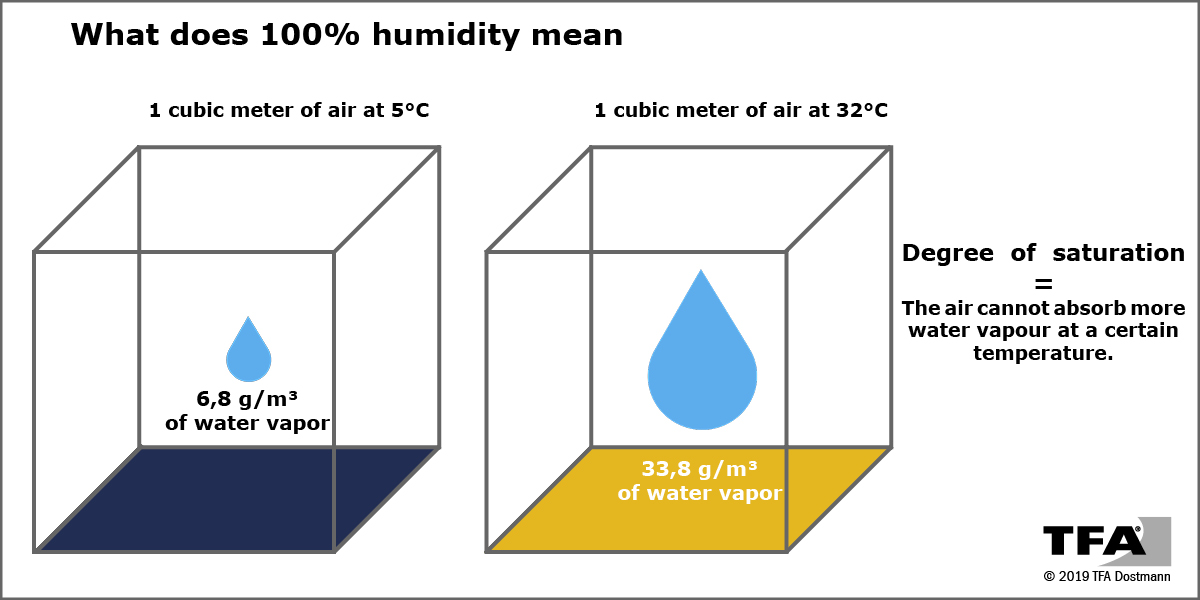
What does 100% humidity mean?
Air temperature, measured with thermometers, determines how much water vapour the air can absorb. Another important concept related to humidity is the dew point, which we explain in more detail further below.
Measuring humidity
To achieve a healthy indoor climate, you first need to measure the current relative humidity.
The formula for relative humidity is:
Relative humidity = absolute humidity / maximum humidity × 100
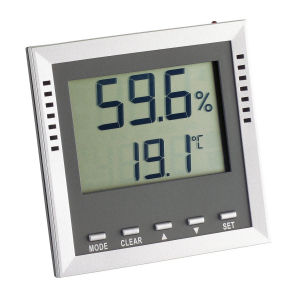
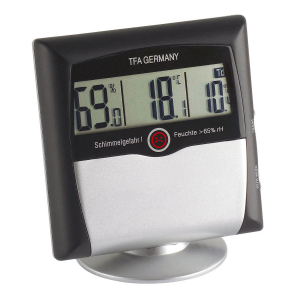
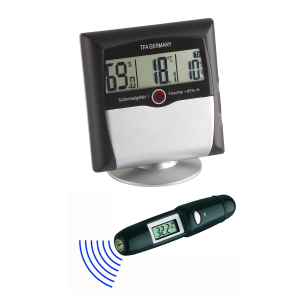
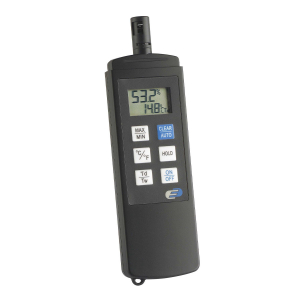
Thermo-hygrometers measure relative humidity for you. Based on these values, you can regulate the indoor climate and keep temperature and humidity within a comfortable range. Do not place the device too close to an external wall or door, window or radiator. Measure humidity regularly. Action is usually only necessary if values are consistently above or below the recommended range for the respective room.
As an alternative, weather stations can be used. Weather stations are all-in-one devices that measure and display various meteorological parameters – including humidity.
Risks of excessively high humidity
Humidity that is too high in indoor spaces can cause discomfort and other health issues. Especially in summer, many people suffer from muggy conditions if no air conditioning is available. Excess moisture can also damage the building structure and furnishings.
At what humidity does mould develop?
If relative humidity is consistently above 60%, mould may develop. A clear mould infestation is likely at around 70%.
In winter, the risk of mould indoors is particularly high. Moisture condenses on cold building surfaces such as windows, corners of walls or roller shutter boxes. If temperatures fall below the dew point, water droplets form and mould or stains may appear.
Mould not only damages the building fabric, but can also be harmful to human health. Inhaling mould spores may contribute to illnesses such as asthma or allergies.
Further risks of very high humidity
Humidity levels above 80% promote the growth of fungi, mites and other pathogens.
High humidity combined with high temperatures is often perceived as unpleasant because sweat cannot evaporate effectively from the skin. If humidity remains high over time, circulation problems and sleep disturbances may occur because the body can no longer regulate its temperature properly.
Effects of low humidity
Dry indoor air is a common problem, particularly during the heating season. If humidity falls below the optimal range, it can irritate the eyes, skin and mucous membranes. A dry throat and nosebleeds may occur. The skin dries out and redness or itching can develop. Low humidity can also weaken the immune system, leading to more frequent colds.
Studies show that higher temperatures and higher humidity levels can slow the spread of viruses. New research from China indicates that higher temperatures and increased humidity significantly reduce the spread of the coronavirus.
In addition to health effects, fluctuating temperatures and low humidity can damage the building structure and furnishings. Wood and other hygroscopic materials such as paper, leather and textiles are sensitive to climate fluctuations and may warp or crack.
Regulating humidity
Showering, cooking and drying laundry: everyday activities continuously release water vapour – around 6 to 12 litres per day in a three-person household. This increases moisture levels in indoor air.
On the other hand, excessive heating and rising room temperatures allow air to hold more moisture, causing relative humidity to drop into an uncomfortable range. Finding the right balance between temperature and humidity is therefore essential. With a hygrometer or thermo-hygrometer, you can keep track of these values.
Tips for a healthy indoor climate
Below are nine practical tips to improve temperature and humidity levels:
- Never turn the heating off completely when leaving the house. Maintaining a reduced but constant temperature helps save energy.
- Keep internal doors between rooms with different temperatures closed during the day and at night.
- Ventilate by opening windows fully for a short time (shock airing). Tilted windows waste heating energy and may even promote mould growth.
- Cross-ventilation (opening windows on opposite sides) is the most effective method.
- Ventilate in all weather conditions – even when it rains. Cold outdoor air is often drier than warm indoor air.
- Remember: the cooler the room temperature, the more often ventilation is required.
- The colder it is outside, the shorter the ventilation time needs to be.
- With tightly sealed insulated windows, ventilate more frequently.
- Ventilate bathrooms and kitchens immediately and as directly as possible to the outside.
Whether ventilation reduces or increases indoor humidity depends on outdoor and indoor conditions. When cold outdoor air warms up indoors, it absorbs moisture and humidity decreases. In summer, when outdoor air is warmer than indoor air, the opposite effect may occur, bringing both heat and moisture inside.
Measure humidity and temperature regularly. At TFA Dostmann you will find analogue and digital humidity meters to help you create a healthy indoor climate.
Specific target values and a room-by-room overview can be found here: Optimal Indoor Humidity – Values, Table & Tips
Reducing humidity
High indoor humidity can usually be reduced through correct and regular ventilation. If your thermo-hygrometer still shows consistently high relative humidity, the following measures can help:
- Place several bowls of salt in the room. Simple table salt is sufficient and should be replaced once there is more water than salt.
- Dry laundry outdoors or use a tumble dryer.
- Reduce indoor plants or move them to other rooms.
- Use the extractor hood while cooking and for some time afterwards.
- In severe cases, use a dehumidifier.
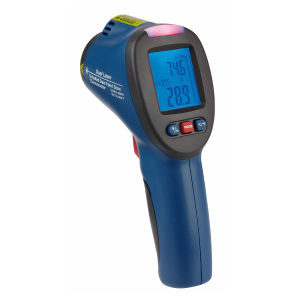
To help prevent mould, air temperature should not drop so low in any part of the room that the dew point is reached. For measuring surface temperatures at potential cold bridges, we recommend suitable measuring devices.
Increasing humidity
Do not overheat your rooms. When temperature drops, relative humidity increases. Indoor plants and indoor fountains can help raise humidity levels.
A well-known home remedy during the heating season is placing a bowl of water on a radiator or hanging damp towels. A humidifier provides faster relief from very dry air.
Important: Use moisture sources in moderation. Without sufficient air exchange, indoor air can quickly become too humid, increasing the risk of mould and salt efflorescence on walls. Furniture, books and other sensitive items may also be damaged by excess moisture.
Dew point and humidity
Warm air can absorb significantly more water vapour than cold air. If the ambient air cools while the absolute humidity remains unchanged, the relative humidity rises to 100%. If the air cools further, the excess water vapour condenses and droplets form.
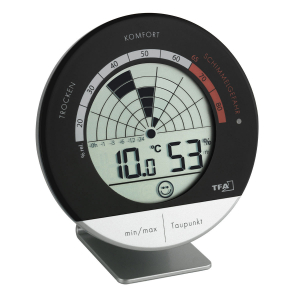
The dew point is the temperature at which this process begins. Relative humidity and air temperature therefore determine the dew point. Using a thermo-hygrometer, relative humidity and room temperature can be measured. Many digital TFA climate measuring devices are also able to calculate and display the dew point.